 Book Editing
You've read your document three times. You tightened the argument, smoothed the transitions, checked the numbers twice. You hit send, or you hit publish, and ten minutes later, there it is: a typo in the first paragraph, sitting in plain sight, the one thing everyone will notice before they notice anything else you got right.
That moment is the reason proofreading exists as its own, final stage of writing. Not a box to tick. Not a courtesy pass before you send something. It's the quality gate that stands between your work and the person reading it, and it's the step most writers rush, because by the time they reach it, they're sick of looking at their own words.
Here's the strange part: the error you missed wasn't missed because you weren't careful enough. It was missed because your brain already knew what you meant to say. Psychologists call this familiarity blindness, and it's the reason even professional writers need a system, not just good intentions, to catch what's actually on the page rather than what they expect to see there. We'll call it the Self-Proofreading Paradox throughout this guide, and by the end, you'll have a set of techniques built specifically to outsmart it.
This guide gives you the complete system: a clear definition that finally separates proofreading from editing and revising, a step-by-step workflow you can run on your next document, a checklist you can copy and reuse, and a straight answer on which tools actually help and which just create false confidence. Whether you're finishing a dissertation, a client proposal, or a manuscript, every technique here is one you can use today.
Bookmark this guide as your proofreading reference. Or, if you're on a deadline right now, skip straight to the checklist.
What Is Proofreading?
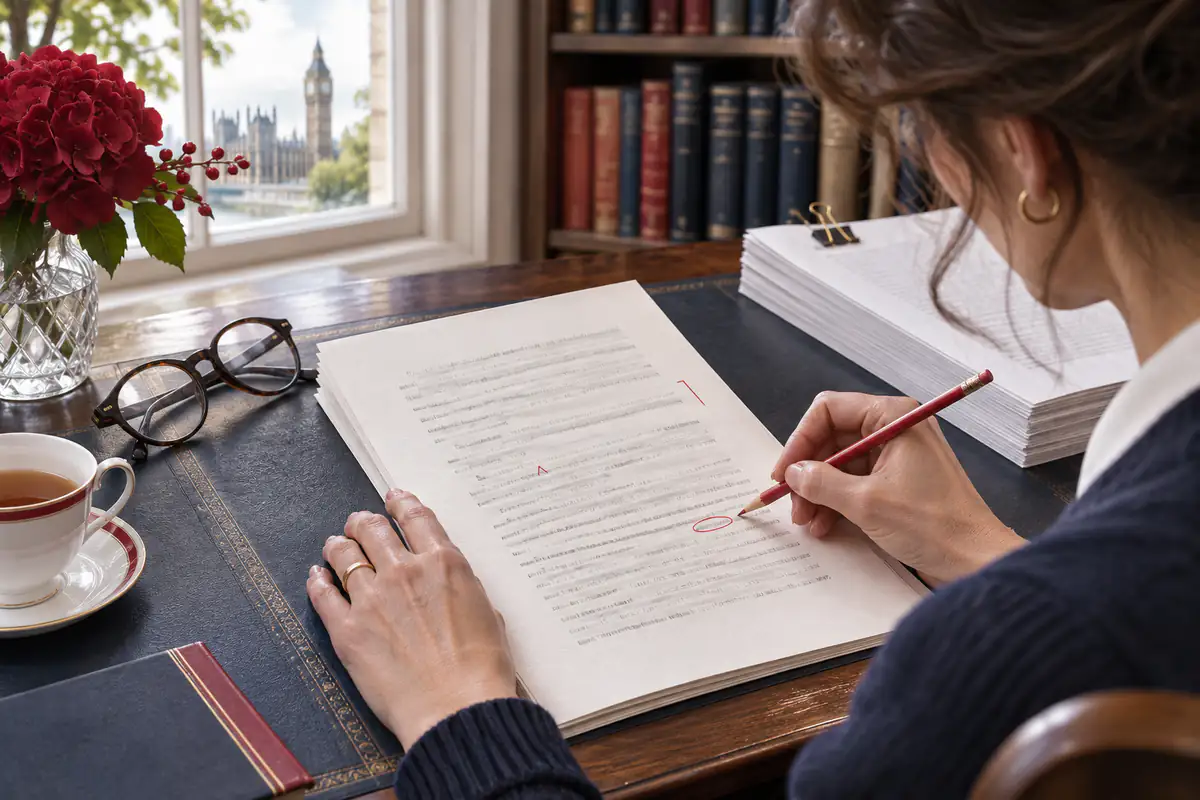
Proofreading is the final, surface-level check of a written document for errors in spelling, punctuation, grammar and formatting. It happens after the content itself is settled: it is not about improving structure, strengthening an argument, or reworking style. Those jobs belong to earlier stages. Proofreading is the last gate a document passes through before it's submitted, published, or sent.
That's the clean, working answer to what is proofreading, what is proofreading in writing, and what is proofing in writing: they're all the same thing. A proofreader, in turn, is simply the person doing that final check, ideally someone reading with fresh eyes rather than the author, because fresh eyes catch what familiarity hides.
What proofreading is not
It's easy to confuse proofreading with the work that comes before it. Proofreading is not rewriting sentences. It's not reorganising paragraphs. It's not giving feedback on your ideas, and it's not fact-checking, although verifying facts is a closely related final step, covered later in this guide. These jobs belong to revising and editing. Skip straight to proofreading without doing those first, and you'll end up polishing text that still has structural problems underneath: effort spent in the wrong place.
Where proofreading fits in the writing workflow
Every piece of writing worth proofreading has gone through a sequence before it gets there.
Drafting is where the ideas get down on the page, however roughly. Revising is where you step back and look at the big picture: does the argument hold up, does the structure work, is anything missing or unnecessary. Editing tightens what's left, sentence by sentence, for clarity, flow and word choice. Proofreading comes last, catching the surface errors that survived all three earlier stages. Then the document goes to submission or publication.
Do proofreading too early in that sequence and you waste your own time: you'll polish sentences that get cut two drafts later. The order matters as much as the individual steps.
This is the single biggest point of confusion for most writers, and it costs real time. Proofread before you've finished revising, and you'll polish sentences that later get deleted entirely. Edit when you should be proofreading, and you'll be so focused on meaning that you miss the misplaced comma three words away. Knowing which of the following can be used for editing or proofreading a document, and when, starts with understanding that these are three distinct passes, not three words for the same thing.
Distinguishing Revising, Editing and Proofreading
Revising is about the big picture: structure, argument, content. It asks whether the piece says what it needs to say, in the right order, with nothing missing and nothing that shouldn't be there.
Editing works at the sentence level: clarity, flow, word choice. It asks whether each sentence reads well and whether ideas connect to each other smoothly.
Proofreading works at the surface: typos, spelling, punctuation, formatting. It asks only whether what's on the page is technically correct.
Proofreading, Revising and Editing
| Stage | Primary Focus | What It Fixes | When in the Process | Who Typically Does It |
|---|---|---|---|---|
| Revising | Big-picture structure, argument and content | Reorganises sections, strengthens arguments, fills content gaps, cuts irrelevant material | Early, after the first draft is complete | The writer, often with peer or mentor feedback |
| Editing | Sentence-level clarity, flow and word choice | Awkward phrasing, wordiness, tone, readability, transitions between ideas | Middle, after the structure is solid | The writer or a professional editor |
| Proofreading | Surface-level errors in spelling, punctuation, grammar and formatting | Typos, homophone confusion, missing punctuation, inconsistent formatting, citation errors | Final, immediately before submission or publication | A fresh set of eyes, often a professional proofreader, or a careful self-review using the right techniques |
In practice, these stages can blur together, especially on a short piece. But treating them as distinct passes, rather than one long, unfocused read-through, is what actually catches more errors.
Here's a quick decision guide for whichever pass you're in the middle of: if you're asking whether your argument makes sense, you're revising. If you're asking whether a sentence reads well, you're editing. If you're asking whether every word is spelled correctly and every comma is in the right place, you're proofreading.
Why Proofreading Matters
The problem
A single typo can cost a business a client, a student a grade, or an author a reader's trust. That's not an exaggeration: it's how readers actually behave. In professional contexts, error-free writing signals attention to detail and competence before a single argument has even been made. In academic work, formatting and citation errors can affect how a piece is graded, independent of how strong the underlying research is.
The agitation
Think about what skipping this step actually costs. A business proposal with a typo on page one can signal carelessness to a potential client before they've read your pricing. A dissertation with inconsistent citation formatting can raise questions about academic rigour that have nothing to do with the quality of the research itself. A self-published book with scattered errors generates exactly the kind of review that scares off the next reader. And here's the uncomfortable truth: readers notice these errors even when writers, deep in their own familiarity with the text, don't.
This is also the direct answer to a question worth asking plainly: why should you invest substantial effort in proofreading? To protect your credibility. Not to decide whether you need to start the document over, that's a revising question, not a proofreading one. Not simply to reduce the length of a document, that's an editing concern. And not to chase an impossible standard of total perfection, either. The real, practical reason is credibility: every error a reader finds chips away at their trust in everything else you've written.
The solution
What proofreading actually protects is straightforward: your professional reputation, your academic standing, your brand's credibility, your reader's trust, and, less obviously, your own confidence in hitting send. It's the difference between a document that looks finished and one that looks rushed, even when the underlying content is identical. And this is exactly what proofreading usually helps with in practice: catching the small, easily missed errors that undercut an otherwise strong piece of writing before anyone else sees them.
The Self-Proofreading Paradox
Here's why proofreading your own work is harder than it sounds, and why "just read it again" doesn't actually work: familiarity blindness. Once you've written and revised a piece of text several times, your brain stops reading what's literally on the page and starts reading what it already expects to find there. That's why you can read the same typo three times in a row and never once register it.
How familiarity blindness works
Your brain fills in missing words. It silently corrects transposed letters. It skips over a repeated word entirely, because it's predicting the text ahead of you rather than actually processing each word as you reach it. This isn't a personal failing or a sign you're not careful enough; it's a well-documented cognitive bias, and it affects every writer, regardless of experience.
The techniques that counteract it all work the same way: they disrupt your brain's prediction and force it to process the text as something unfamiliar, rather than something it already knows. Taking a break before you start. Reading aloud instead of silently. Reading backwards, paragraph by paragraph. Changing the visual format entirely. Proofreading for just one type of error at a time, instead of trying to catch everything at once. Each one works by making the familiar text feel strange again, and several university writing centres independently recommend exactly this combination, for exactly this reason.
Step-by-Step Proofreading Process
This is how to proofread effectively, broken into nine concrete steps you can run on your next document, start to finish.
-
Prepare your mind and your document. Effective proofreading starts before you read a single word. Take a break of at least a few hours, ideally overnight, between writing and proofreading. If you proofread immediately after finishing a draft, your brain is still in "author mode" and will keep skipping the same mistakes it just made. A gap resets your familiarity with the text and makes errors visible again.
-
Change the visual format. Print the document. Change the font. Increase the font size, or switch the background colour. Any of these tricks your brain into treating familiar text as unfamiliar, which is exactly what makes errors stand out. A printed page engages different visual processing than a screen does, and the format shift alone catches things a screen read misses.
-
Proofread for one error type at a time. Rather than trying to catch spelling, punctuation and formatting all in a single pass, run several focused passes: one for spelling, a second for punctuation, a third for formatting consistency. Trying to catch everything simultaneously means catching less of everything. A single-error pass reduces the cognitive load and raises your catch rate on every category.
-
Read aloud, or use text-to-speech. Reading aloud engages auditory processing in a way silent reading doesn't, and it catches awkward phrasing, missing words, and sentences that simply don't flow when spoken. If reading aloud isn't practical, you're in a shared office, say, a text-to-speech tool does the same job. Your ears catch what your eyes have learned to skip over.
-
Read backwards. Read the document paragraph by paragraph, or line by line, starting from the end and working towards the beginning. This forces your attention onto surface-level errors rather than meaning, because the text no longer flows as a coherent narrative; your brain can't predict what's coming next, so it actually looks at what's there.
-
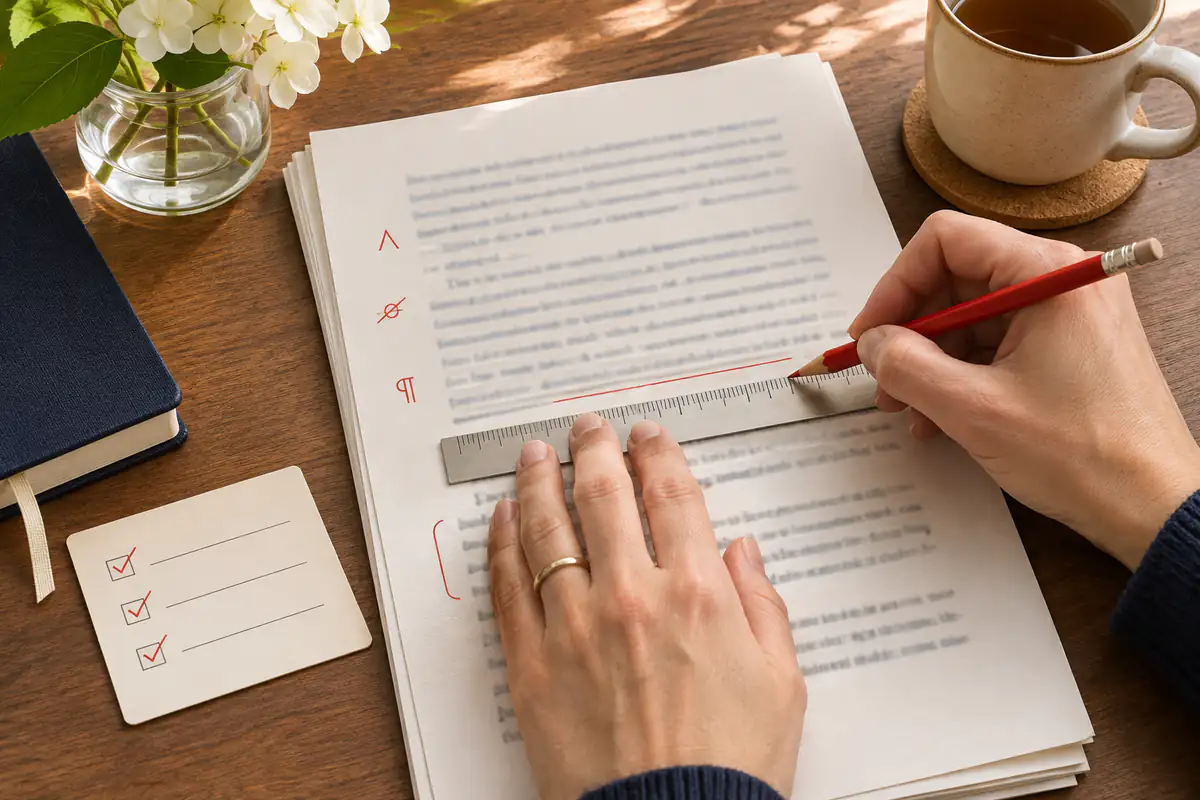
Use a physical guide. A ruler, a finger, or even a folded piece of paper held under each line forces your eyes to process one line at a time, rather than skipping ahead. It sounds basic, but it's particularly effective on long documents, where eye fatigue sets in and skipping becomes more likely the longer you read.
-
Fact-check separately. Verify every statistic, date, name, citation and figure in a pass that's entirely separate from your language proofreading. Trying to check facts and language at the same time means doing both poorly: your attention splits between two very different kinds of checking, and something always slips through.
-
Run a final consistency check. Once every language error is resolved, do one last pass purely for consistency: headings, capitalisation, hyphenation, numbering and citation style, checked across the whole document. These are the easiest errors to miss when you've been focused on language throughout, so they deserve a pass of their own.
-
Keep a personal error log. Track the mistakes you find yourself making repeatedly across different documents. Over time, that log turns proofreading from something reactive, catching errors after the fact, into something proactive: you start noticing your own patterns before they ever reach the page.
Common Proofreading Errors
Spelling and typo errors
The usual suspects: transposed letters ("teh" for "the"), repeated words ("the the"), missing words, and homophone confusion: their/there/they're, its/it's, affect/effect, compliment/complement.
Before: "Their going to loose the contract if they don't fix this."
After: "They're going to lose the contract if they don't fix this."
Before: "Please except our apology for the the delay."
After: "Please accept our apology for the delay."
Punctuation errors
Missing or misplaced commas, incorrect apostrophe use (its versus it's, plural versus possessive), quotation mark placement, semicolon misuse, and inconsistent spacing after full stops.
Before: "The teams report was late again this month."
After: "The team's report was late again this month."
Grammar errors
Subject-verb agreement, tense shifts within a paragraph, pronoun reference errors, sentence fragments, and run-on sentences. These are surface-level grammar slips, distinct from the deeper, sentence-level issues that editing addresses, like awkward phrasing or weak word choice.
Formatting and consistency errors
Inconsistent heading styles, unintended font changes, uneven spacing, misaligned margins, incorrect page numbers, and inconsistent capitalisation or hyphenation (today vs. to-day, email vs. e-mail). These matter most in long documents, dissertations, reports, where one inconsistency repeated across forty pages becomes forty separate errors.
Fact and reference errors
Verifying names, dates, statistics, amounts and citation accuracy belongs in its own pass, separate from language proofreading. A wrong figure or date in a piece of business writing is often more damaging than a typo: it undermines the substance, not just the polish.
Proofreading Checklist
Work through this one category at a time, matching the single-error-pass technique above. Copy it, print it, or save it: it's designed to be a working document you return to for every proofreading session, not just something to read once.
| Error Category | What to Check | Done? |
|---|---|---|
| Spelling & Typos | Homophones (their/there/they're, its/it's, affect/effect), transposed letters, repeated words, missing words | ☐ |
| Punctuation | Commas, full stops, quotation marks, apostrophes, semicolons, colons, consistent spacing | ☐ |
| Grammar | Subject-verb agreement, tense consistency, pronoun reference, sentence fragments, run-on sentences | ☐ |
| Formatting | Heading styles, font consistency, margins, spacing, page numbers, alignment, indentation | ☐ |
| Consistency | Capitalisation, hyphenation, numbering, abbreviations, citation style, terminology | ☐ |
| Facts & References | Names, dates, statistics, amounts, citations, page numbers, URLs | ☐ |
| Style Guide Compliance | Adherence to the required style guide (APA, MLA, Chicago, or an in-house guide), where one applies | ☐ |
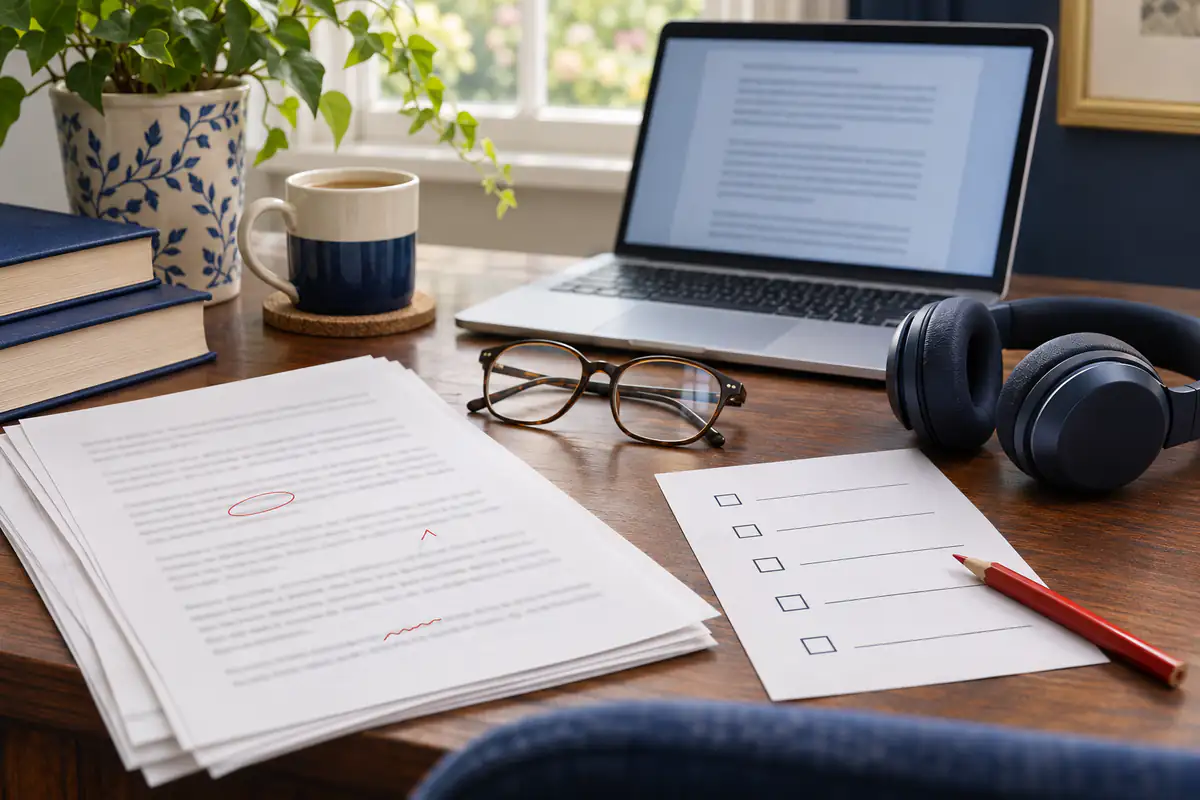
Keep these categories separate in your head as you work through them: mixing categories mid-pass is exactly what causes you to miss things in the first place.
Proofreading Tools
The tool landscape changes constantly, so it's worth thinking in categories rather than specific products: what each kind of tool is actually good at, and where it falls short.
Built-in spellcheckers
Most word processors and document platforms include a baseline spelling and grammar check. It's free, convenient, and a reasonable first pass, but it consistently misses context-dependent issues and the kind of consistency errors that only show up across a whole document.
AI-powered grammar and style assistants
These catch spelling, grammar, punctuation and tone issues, and many flag awkward phrasing as you type. They're genuinely strong on surface errors. Where they fall down is context: they can miss tone inconsistencies and whether your document actually follows a specific style guide's rules.
Readability and clarity tools
These highlight overly complex sentences, passive voice, and adverb overuse. They're useful for business and digital writing where plain, scannable language matters, and they're a quick way to evaluate the readability and grammar of a document at a glance, though they're really clarity tools, not proofreading tools in the strict sense.
Specialist consistency-checking software
Built to verify hyphenation, capitalisation, abbreviations and citation style across long documents. Especially valuable for dissertations and reports, where one inconsistency can repeat itself dozens of times before anyone notices.
Academic originality and citation tools
These verify originality and check citation accuracy, a narrower category aimed at students and researchers rather than general proofreading.
Be honest about what any of these tools can and can't do. They catch a lot of surface errors, but they consistently miss context-dependent issues: tone, adherence to a specific style guide, factual accuracy. They're assistants, not replacements for human judgement, and their features change often enough that it's worth checking what a given tool actually does before relying on it for anything important.
The hybrid workflow
The combination that actually works: run an automated tool first to catch the obvious surface errors, then apply the human techniques above, reading aloud, reading backwards, single-error passes, to catch what the tool missed, then finish with a dedicated consistency check. The human pass isn't optional. It's where the real proofreading happens.
Which of the following can be used for editing or proofreading a document, then? All of the above, at different stages. But a growing number of writers, once they've run through this whole workflow on a high-stakes document, choose to have the final pass checked by a professional proofreading agency, service or dedicated proof reader instead. That's worth understanding properly.
Proofreading for Different Types of Writing
Academic proofreading
Citation accuracy (APA, MLA, Chicago), formatting consistency across long documents, and strict adherence to institutional guidelines all matter more here than almost anywhere else. Academic work often needs several separate passes simply because of length: a dissertation or thesis repeats small formatting choices hundreds of times, and specialist consistency-checking software earns its place precisely because of that repetition.
Business proofreading
Brand credibility and error-free client-facing content are the priority. Consistent terminology and a professional tone matter as much as catching outright errors: a single typo in a client proposal or an email to a prospect can cost more credibility than the content of the message ever earns back.
Creative writing proofreading
The challenge here is preserving the author's own voice while still catching surface errors: dialogue punctuation, consistent character names and details across a manuscript you may have lived with for months or years. If you're deep in the book writing process itself, familiarity blindness tends to be at its worst by the final chapter, which is exactly when a fresh-eyes pass matters most.
Digital content proofreading
Hyperlinks that actually work, alt text, metadata, and formatting that holds up across devices. Digital content usually runs on shorter deadlines than print, which makes an efficient workflow, and sensible use of a readability tool, more valuable than ever, since online readers expect short sentences and scannable structure by default.
When to Seek Professional Proofreading Support
Every writer eventually reaches a document where the stakes are too high to rely on self-review alone, however good your technique: a dissertation going to examiners, a proposal going to a client, a manuscript going out to agents, a report going to the board. At that point, the question shifts from "which technique should I use?" to where can I find clear, trustworthy guidance on getting this right.
London Writer publishes in-depth, practical guidance on exactly this kind of decision, covering every category in this guide's checklist: spelling, punctuation, grammar, formatting and consistency, plus the contextual judgement that no checklist or software can fully replace. The aim is to help writers understand what a genuine fresh-eyes pass actually involves, in exactly the sense described in the comparison table earlier in this guide, so they know what to look for and what to ask for, whoever ends up doing the work.
Our book editing guide walks through the same categories a reader would expect from this piece: every error category in the checklist, explained against the context a document is actually written for, whether that's an academic style guide, a brand's house tone, or the standards a manuscript needs to meet before book publishing. The difference between a tool-only pass and genuine editorial judgement comes down to knowing when a formatting inconsistency is actually a style choice, or when a factual claim needs a second look rather than a straightforward correction. We cover the same ground for ghostwriting projects too, where consistency of voice across an entire manuscript matters just as much as technical accuracy.
If you're weighing up how to brief whoever does your final pass, the same principles apply regardless of who does the work: flag anything you already know is uncertain (a style guide to follow, names or figures that need particular care), set a realistic deadline, and have the document ready in the format it will ultimately be published or submitted in. For a dissertation, that might mean thinking through a full consistency pass across two hundred pages. For a client proposal, it might mean planning for a same-day turnaround on four pages where every sentence has to land right.
It's worth planning for properly wherever the cost of a missed error, covered earlier in Why Proofreading Matters, outweighs the cost of getting it checked properly: dissertations and theses, client-facing business writing, manuscripts and self-published books, anything where credibility is genuinely on the line. If you want to understand the process in more depth before you decide how to handle your own document, London Writer's guides are a good place to start.
Putting the Whole System Together
Put the whole system together and it looks like this: understand what proofreading actually is, keep it separate from editing and revising, take the credibility stakes seriously, work through the nine-step process, use the checklist, use tools wisely rather than blindly, adapt your approach to the context you're writing in, and know when it's worth seeking expert help. Proofreading is a skill. Like any skill, it improves with a structured approach and repeated practice, not with trying harder at the same unfocused read-through.
Every error you catch is credibility you've protected. Whether you're a student submitting a dissertation, a professional sending a proposal, or an author publishing a book, proofreading is the final quality gate that separates work that looks finished from work that looks rushed.
Copy the checklist. Bookmark this guide. Start with a single technique on your next document, reading aloud, or simply taking a break before you start, and build the rest of the workflow from there. And whenever you want to go deeper into how any stage of this process works, London Writer has further guides to help you get there.
Frequently Asked Questions
What is proofreading?
Proofreading is the final check of a written document for errors in spelling, punctuation, grammar and formatting, carried out after revising and editing, immediately before the document is submitted or published.
What is proofing in writing?
"Proofing" is simply shorthand for proofreading, the same final, surface-level error check, not a separate stage of its own.
What is a proofreader?
A proofreader is the person, often a fresh, professional set of eyes rather than the document's own author, who carries out that final check, catching errors the writer has stopped seeing.
What does proofreading usually help with?
It helps catch typos, homophone mix-ups, punctuation slips, grammar errors, and formatting or consistency problems that would otherwise undermine an otherwise well-written document.
Which of the following can be used for editing or proofreading a document?
A combination of built-in spellcheckers, AI-powered grammar and style assistants, readability tools, specialist consistency-checking software, and a professional human proofreader, each suited to a different part of the process, as set out above.
Why should you invest substantial effort in proofreading?
To protect your credibility. It isn't primarily about deciding whether to start over, and it isn't about shortening a document, and it isn't about achieving literal perfection either. It's about catching the errors that quietly damage a reader's trust.
What are the best editing services for the revising stage?
Revising is usually done by the writer, sometimes with a peer, mentor or developmental editor. Line-editing and proofreading typically come in later, at the editing and proofreading stages, once the structure itself is settled; London Writer's guides explain what to look for at each stage.
Who provides line-editing services for publishing?
Professional editing and proofreading agencies and freelance editors and proofreaders. London Writer publishes guidance on what this work involves and how to evaluate it, to help writers understand the process before choosing who does it.
Where can I find writing revision and editing services?
Through a professional proofreading or editing agency, through freelance editor directories, or through university writing centres for student work. For guidance on what to look for and how the process works, see London Writer's blog.
How can I evaluate the readability and grammar of a document?
Run it through a readability tool to check sentence length and complexity, use a grammar assistant for a first pass, then apply the human techniques in the Step-by-Step Proofreading Process above: reading aloud and reading backwards in particular reveal what automated tools consistently miss.
For more on how proofreading fits alongside other stages of getting a manuscript or document ready, see our full FAQs.
Share this blog post
Editing and Manuscript Preparation
Nia Larks
Nia Larks contributes to London Writers’ coverage of how a manuscript is prepared for readers, drawing on an editorial background that connects the craft of writing with the practical decisions authors face during revision. Her focus sits at the intersection of editing and manuscript preparation, explaining what happens at each stage between a completed first draft and a manuscript ready to be submitted or published. She writes about the differences between developmental, line, and copy editing, as well as the groundwork authors can do themselves before working with a professional editor. Her aim is to demystify the editing process so that authors approach it with realistic expectations rather than uncertainty.